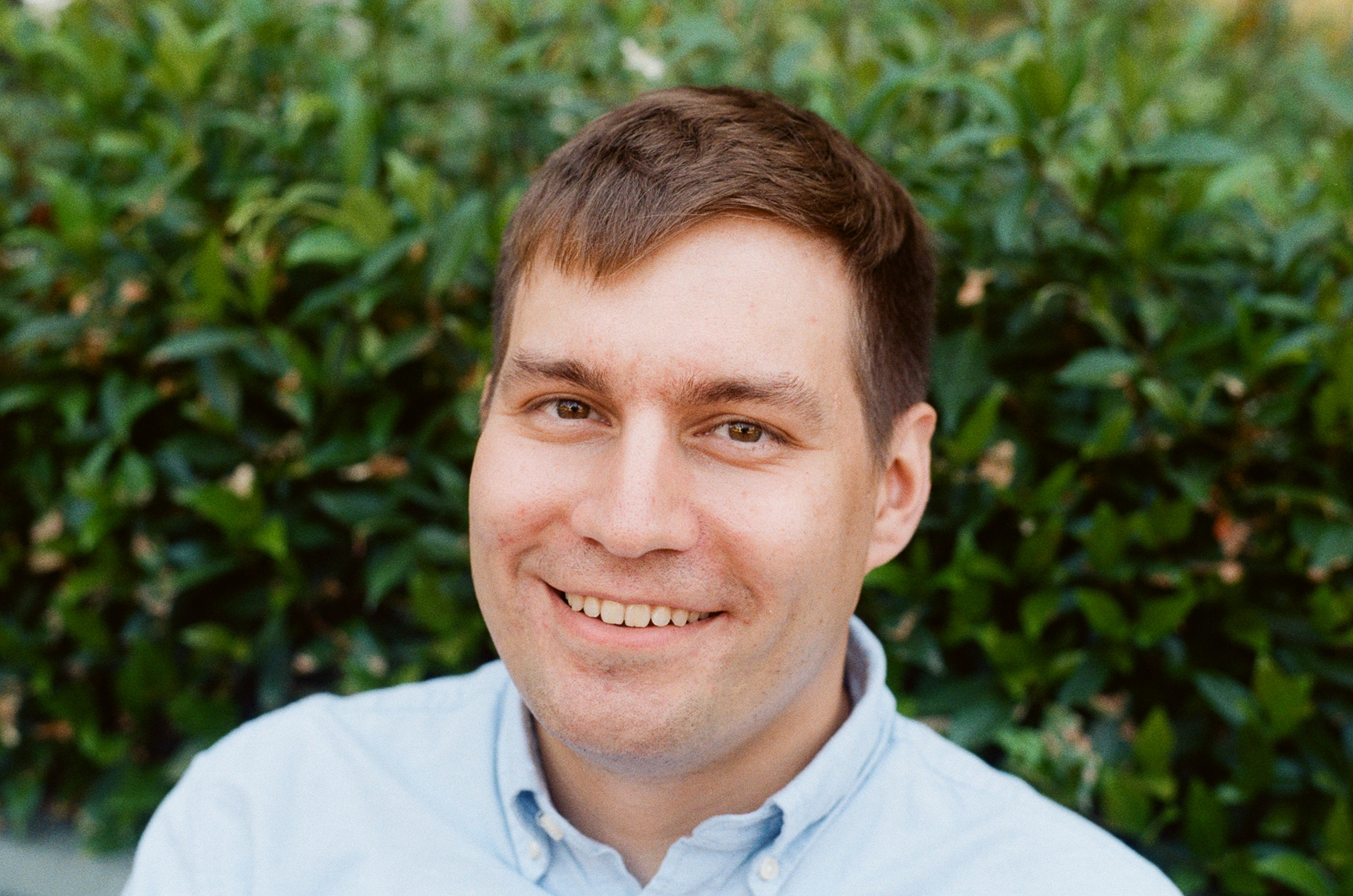
Portrait of Ilia Nekrasov

I am a mathematician and a Lovett Instructor at Rice University. Previously I was a Morrey Visiting Professor at UC Berkeley. I received my Ph.D. with Andrew Snowden at the University of Michigan.

My primary interests lie in tensor categories and combinatorial model theory. More generally, I am interested in algebra, topology, and mathematical physics.

Research

Symmetric Tensor Categories and Model Theory

Upper bounds for measures on distal classes ArXiv

joint with A. Snowden
Submitted

Arboreal tensor categories ArXiv

joint with A. Snowden and N. Harman
Selecta Math. (N.S.) 31 (2025), no. 58

Tensorial Measures on Omega-Categorical Structures

Ph.D. Thesis
Repository Link

Classification of Overgroups in Lie Groups

Overgroups of exterior powers of an elementary group. Normalizers ArXiv

joint with R. Lubkov
Documenta Math. 29 (2024), no. 5

Overgroups of exterior powers of an elementary group. Levels ArXiv

joint with R. Lubkov
Linear and Multilinear Algebra, 72 (2024), no. 4

Explicit equations for exterior square of the general linear group ArXiv

joint with R. Lubkov
J Math Sci 243 (2019)

Equivariant Noetherianity of Algebraic Spaces

Dual Infinite Wedge is GL∞GL_{\infty}-equivariantly noetherian ArXiv

Compactifications of M0,n\mathcal{M}_{0,n}, Alexander self-dual complexes, and Polygon Spaces

Compactifications of M0,n\mathcal{M}_{0,n} associated with Alexander self-dual complexes: Chow ring, ψ\psi-classes and intersection numbers ArXiv

joint with G. Panina
Proc. Steklov Inst. Math. 305 (2019)

Geometric presentation for the cohomology ring of polygon spaces ArXiv

joint with G. Panina
St. Petersburg Math. J. 31 (2020)

Intersection numbers of Chern classes of tautological line bundles on the moduli spaces of flexible polygons ArXiv

joint with G. Panina and A. Zhukova

Alexander rr-tuples and Bier complexes ArXiv

joint with G. Panina, D. Jojić, and R. Živaljević
Publications de l'Institut Mathematique 104 (2018), issue 118

Cyclopermutohedron

Cyclopermutohedron: geometry and topology ArXiv

joint with G. Panina and A. Zhukova
European Journal of Mathematics 2 (2016)

Volume and lattice points counting for the cyclopermutohedron ArXiv

joint with G. Panina

Formal Modules and Arithmetic in Local Fields

Cohomology of Formal Modules over Local Fields

joint with S. Vostokov
Math Notes 105 (2019)

Explicit constructions and arithmetic of local number fields

joint with S. Vostokov, S. Afanaseva, M. Bondarko, V. Volkov, O. Demchenko, E. Ikonnikova, I. Zhukov, P. Pital’
Vestnik of Saint Petersburg University 4 (2017), no. 3

Lutz filtration as a Galois module

joint with S. Vostokov and R. Vostokova
Lobachevskii J Math 37 (2016)

The Lubin–Tate Formal Module in a Cyclic Unramified pp-Extension as a Galois Module

joint with S. Vostokov
J Math Sci 219 (2016)

Teaching

Below is information on recent courses I have taught. Other pedagogical and instructional roles, including course coordination, can be found in my CV.

Algebra

Honors Introduction to Abstract Algebra

Upper-division undergraduate course · Lecture-based with in-depth homework assignments

We covered core and intermediate topics from group theory and ring theory. Highlights include the Sylow theorems in the structure theory of finite groups, the ping-pong lemma in group actions, the classification of finitely generated abelian groups via modules over principal ideal domains, and ideal-theoretic perspectives on the Fundamental Theorem of Arithmetic.

Mainly, we used Abstract Algebra by T. Judson and Algebra: Chapter 0 by P. Aluffi.
Canvas link: Fall 2025

Introduction to Abstract Algebra

Upper-division undergraduate course · Lecture-based

We covered core topics from group theory, ring theory, and theory of fields. Highlights include the classification of finite abelian groups, Burnside’s lemma in group actions, the Fundamental Theorem of Arithmetic for principal ideal domains and its extension to ideal factorization, and an introduction to splitting fields.

Mainly, we used Abstract Algebra by T. Judson.
Canvas links: Fall 2024, Spring 2024

Analysis

Introduction to Complex Analysis

Upper-division undergraduate course · Lecture-based

We covered core topics in the theory of analytic functions and the calculus of residues, with the exposition taking a more geometric perspective than the standard analytic approach. Along the way, we introduced the Riemann sphere as a complex manifold and developed holomorphic and meromorphic functions, as well as differential forms, on the complex plane and on the Riemann sphere. Highlights included Cauchy’s theorems, residue theory on the Riemann sphere, the theory of Möbius transformations of the Riemann sphere, and their use in complex integrals.

Mainly, we used Basic Complex Analysis by J. Marsden and M. Hoffman.
Canvas links: Fall 2025, Spring 2026

Calculus II

Lower-division undergraduate course · Active learning

The course was focused on the definite integral and its interpretations, techniques for constructing antiderivatives, and methods of integration, including substitution, integration by parts, trigonometric substitutions, and improper integrals. Applications of integration included area and volume, physical and geometric applications, probability and distributions, and numerical integration. The course concluded with sequences and series, covering convergence tests, power series, and Taylor polynomials and series as tools for function approximation.

We used Calculus: Single Variable by W. McCallum, D. Hughes-Hallett, and A. Gleason.
Canvas links: Spring 2022, Fall 2019

Calculus I

Lower-division undergraduate course · Active learning

The course covered foundational topics in differential and integral calculus. Specifically, we studied functions and limits, continuity, and the derivative as a rate of change, followed by techniques of differentiation and the Mean Value Theorem. Applications of derivatives included optimization, related rates, and curve sketching. The course concluded with an introduction to the definite integral, its interpretation via the Fundamental Theorem of Calculus, and basic techniques for constructing antiderivatives.

We used Calculus: Single Variable by W. McCallum, D. Hughes-Hallett, and A. Gleason.
Canvas links: Fall 2022, Winter 2022, Fall 2020, Winter 2019, Fall 2018

Advising

Note for students: If you are interested in a reading course or a similar independent study, email me! Working in a small group—for example, with a classmate—is often even more productive.

Reading Courses

Model Theory and Combinatorics of Oligomorphic Groups

In-depth analysis of combinatorial and model-theoretic structures related to actions of oligomorphic groups.

We mainly used Oligomorphic Permutation Groups and Permutation Groups by P. Cameron.

Introduction to Representation Theory

The course covers core ideas of representation theory of finite groups over characteristic zero. We usually go through Linear Representations of Finite Groups by Jean-Pierre Serre, with a plethora of exercises and problems exploring representations of abelian, symmetric, and dihedral groups.

Introduction to Local Number Theory

The course mainly followed A Classical Introduction to Modern Number Theory by K. Ireland and M. Rosen, with special emphasis on Reciprocity Laws.

Honors and Master Theses

Identities on the Theta Ring of Simple Loopless Graphs

by Aaron F. Burnham-Schmidt, UIUC.

Categorification and Combinatorics on Oligomorphic Permutation Groups

by Ali Ziyad Lone.

Lubin–Tate extensions and Carlitz module over a projective line

by Nikita Elizarov, Universität Bielefeld. The thesis led to a published paper.

Other advising and mentoring activities can be found in my CV.

Contact

You can contact me via email at ilia.nekrasov@rice.edu.

My office is in Herman Brown Hall, Room 444.

Correspondence should be addressed to:

Department of Mathematics
Rice University, MS 136
6100 Main St.
Houston, TX 77005